


Introduction
Few pieces of jewelry have managed to remain relevant across thousands of years, countless civilizations, and every shift in fashion quite like the gold earring. From the tombs of ancient Egyptian pharaohs to the ears of modern-day celebrities walking red carpets, gold earring have consistently represented wealth, status, beauty, and personal identity. They are not just accessories; they are cultural artifacts that tell stories of trade routes, religious beliefs, social hierarchies, and artistic movements.
Gold, as a metal, has always held a special place in human history. Its resistance to tarnish, its warm luster, and its rarity have made it the metal of choice for adornment since the earliest days of metallurgy. Earrings, in particular, have a unique relationship with gold because of their visibility—worn close to the face, they draw attention and become an extension of a person’s identity and expression.
This article explores the fascinating world of gold earring in depth: their history, cultural significance, types, craftsmanship, buying considerations, care, and their enduring role in fashion and society today.
A Brief History of Gold Earring
Ancient Origins
The history of gold earring stretches back more than 5,000 years. Archaeological evidence suggests that some of the earliest gold earring were crafted in the region of modern-day Iraq, in ancient Mesopotamia, around 2500 BCE. These early pieces were often simple hoops or crescent-shaped designs, reflecting the limited but skilled metalworking techniques of the time.
In ancient Egypt, gold earring became a powerful symbol of status and divinity. Egyptians believed gold was the flesh of the gods, particularly associated with the sun god Ra, and wearing gold was thought to bring the wearer closer to the divine. Pharaohs and nobility wore elaborate gold earring featuring hoops, studs, and pendant designs, often inlaid with precious stones like lapis lazuli, turquoise, and carnelian. Tutankhamun’s tomb, discovered in 1922, contained several gold earring that showcased the incredible craftsmanship of the era, including intricate granulation and filigree work.
Classical Civilizations
The Greeks and Romans further advanced the art of gold earring making. Greek goldsmiths were known for their delicate and detailed designs, often incorporating imagery of gods, animals, and mythological creatures. Earrings from this era frequently featured drop designs with small figures or amphorae dangling from the earlobe.
Roman society, meanwhile, used gold earring as clear markers of social class and wealth. Wealthy Roman women wore large, ornate gold earring studded with pearls and gemstones, while more modest designs were accessible to the middle classes. The Romans also popularized the use of gold earring set with colored gemstones, a trend that would influence jewelry design for centuries.
Asian and Middle Eastern Traditions
In India, gold earrings have held deep cultural and religious significance for thousands of years. Traditional Indian jhumkas (bell-shaped earrings) and jhumar designs are still popular today, often worn during weddings and religious ceremonies. Gold is considered auspicious in Hindu culture, associated with prosperity and the goddess Lakshmi, making gold earring a staple in bridal jewelry sets.
In the Middle East, gold earring have long been associated with dowries and family wealth. Intricate designs featuring filigree work, a technique using fine gold wires twisted into decorative patterns, became a hallmark of Middle Eastern and North African craftsmanship. These pieces were often passed down through generations, representing not just beauty but familial legacy.
In China, gold earring were historically reserved for the elite and often featured auspicious symbols like dragons, phoenixes, and lotus flowers. Gold jewelry was deeply tied to concepts of luck, protection, and social standing throughout Chinese dynastic history.
Medieval and Renaissance Periods
During the medieval period in Europe, earrings temporarily fell out of favor due to religious conservatism and changing hairstyles that covered the ears. However, gold earring saw a resurgence during the Renaissance, as fashion embraced more elaborate hairstyles and clothing that exposed the neck and ears. Wealthy patrons commissioned goldsmiths to create ornate pieces featuring pearls, gemstones, and intricate metalwork, often as a display of wealth and artistic patronage.
The Modern Era
The 19th and 20th centuries brought significant changes to earring design, driven by industrialization, changing social norms, and evolving fashion trends. The invention of new tools and techniques allowed for mass production of gold earring, making them more accessible to the middle class. Art Nouveau and Art Deco movements introduced bold geometric shapes and nature-inspired designs, while the mid-20th century saw a shift toward minimalist and modernist aesthetics.
Today, gold earring continue to evolve, blending traditional craftsmanship with contemporary design sensibilities, reflecting both cultural heritage and modern individuality.
Why Gold? The Enduring Appeal of the Metal
Gold’s popularity as a material for earrings is not accidental. Several inherent properties make it uniquely suited for jewelry:
Durability and Resistance to Tarnish: Unlike silver or base metals, gold does not corrode, rust, or tarnish easily. This makes it ideal for jewelry worn daily, including earrings that come into contact with skin, sweat, and environmental elements.
Malleability: Gold is one of the most malleable metals known, meaning it can be hammered, stretched, and shaped into intricate designs without breaking. This property has allowed goldsmiths throughout history to create delicate filigree work, detailed engravings, and complex three-dimensional forms.
Hypoallergenic Properties: Pure gold is generally hypoallergenic, making it a safer choice for people with sensitive skin or metal allergies, particularly important for earrings that are in direct, prolonged contact with pierced skin.
Symbolic Value: Beyond its physical properties, gold carries deep symbolic weight across cultures—representing wealth, power, divinity, purity, and permanence. This symbolism has cemented gold’s status as the metal of choice for meaningful, ceremonial, and status-related jewelry.
Investment Value: Gold’s status as a precious metal means that gold earring often retain or increase in value over time, making them not just a fashion statement but also a form of tangible investment.
Understanding Gold Purity: Karats Explained
One of the most important things to understand when purchasing gold earring is the concept of karats, which measures the purity of gold in an alloy.
24 Karat Gold (24K): This is pure gold, containing 99.9% gold content. While stunningly rich in color, 24K gold is very soft and malleable, making it less durable for everyday jewelry like earrings, which are prone to bending or damage.
22 Karat Gold (22K): Containing about 91.6% gold, 22K gold is commonly used in traditional and cultural jewelry, particularly in South Asian and Middle Eastern designs. It offers a rich golden hue while being slightly more durable than 24K gold.
18 Karat Gold (18K): With 75% gold content, 18K gold strikes a balance between purity and durability. It’s a popular choice for fine jewelry, including earrings, because it maintains a beautiful gold color while being sturdy enough for daily wear.
14 Karat Gold (14K): Containing about 58.3% gold, 14K gold is one of the most popular choices for earrings in Western markets. It offers excellent durability, making it ideal for pieces worn frequently, and is generally more affordable than higher karat options.
10 Karat Gold (10K): With only 41.7% gold content, 10K gold is the most durable and affordable option, though it has a lighter, less rich gold color. This is often used for budget-friendly earrings or pieces designed for children.
The choice of karat often depends on the intended use of the earrings—ceremonial or investment pieces might favor higher karats, while everyday wear pieces often opt for 14K or 18K gold for practicality.
Types and Styles of Gold Earring
Gold earring come in an incredible variety of styles, each with its own history, purpose, and aesthetic appeal.
Hoop Earrings
Hoop earrings are among the oldest and most enduring earring styles, dating back to ancient civilizations. Ranging from small, delicate hoops to large statement pieces, gold hoops remain a versatile and timeless choice. They have been reclaimed and reinvented by various cultures and fashion movements throughout history, symbolizing everything from status to rebellion.
Stud Earrings
Simple, elegant, and versatile, stud earrings sit directly on the earlobe without any dangling elements. Gold studs are a staple in everyday jewelry collections, ranging from minimalist round studs to more elaborate designs featuring gemstones or intricate patterns.
Drop and Dangle Earrings
These earrings extend below the earlobe, often featuring chains, gemstones, or decorative elements. Drop earrings can range from subtle and elegant to bold and elaborate, making them popular choices for both everyday wear and special occasions.
Chandelier Earrings
Named for their resemblance to hanging light fixtures, chandelier earrings are elaborate, multi-tiered designs often featuring intricate goldwork combined with gemstones or pearls. These are typically reserved for formal events and special occasions due to their size and ornate detailing.
Huggie Earrings
A more modern take on the hoop, huggie earrings are small, snug hoops that “hug” the earlobe closely. They offer a subtle, elegant alternative to larger hoops while maintaining a similar aesthetic appeal.
Jhumkas and Traditional Ethnic Designs
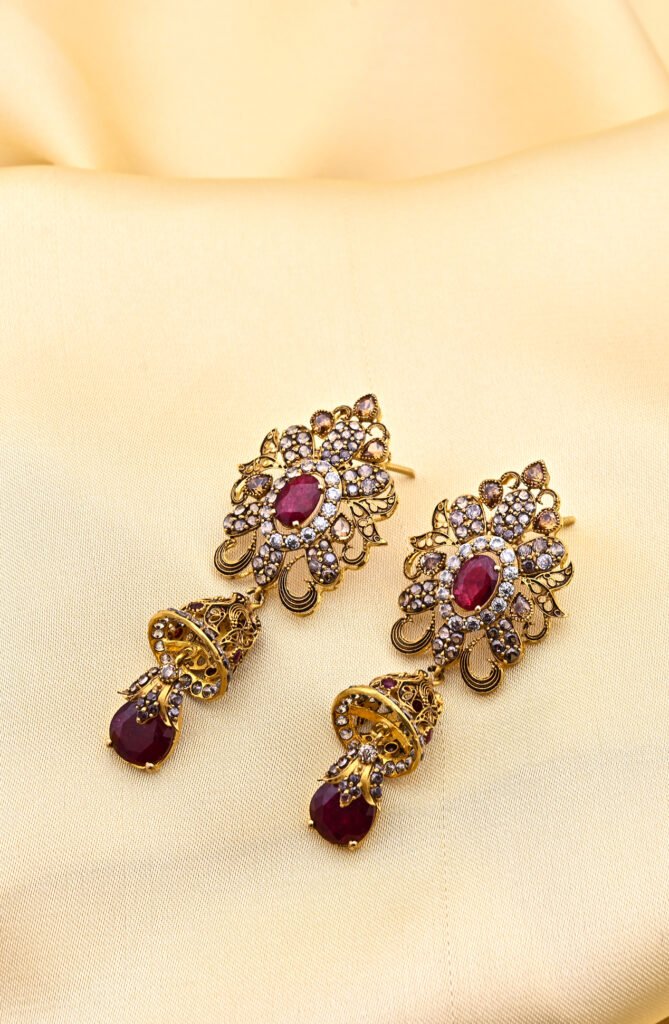
Particularly popular in South Asian cultures, jhumkas are bell-shaped gold earrings often adorned with intricate filigree work, gemstones, and pearls. These traditional designs carry deep cultural significance and are often worn during weddings and religious ceremonies.
Threader Earrings
A contemporary style, threader earrings feature a thin gold chain that is “threaded” through the ear piercing, creating a minimalist, elongated look. This style has gained popularity in recent years among those seeking modern, understated jewelry options.
The Craftsmanship Behind Gold Earrings
Creating gold earrings involves a combination of traditional techniques and modern technology, depending on the complexity and style of the piece.
Casting: This is one of the most common methods for producing gold earrings, particularly for designs requiring intricate detail. Molten gold is poured into a mold, allowed to cool and solidify, and then finished by hand to add detail and polish.
Filigree Work: A technique with ancient origins, filigree involves twisting and shaping fine gold wires into delicate, lace-like patterns. This labor-intensive process requires exceptional skill and is often used in traditional and ceremonial jewelry designs.
Granulation: This ancient technique involves fusing tiny gold spheres onto a surface to create textured, decorative patterns. Popularized by ancient Etruscan and Egyptian goldsmiths, granulation remains a hallmark of fine, handcrafted gold jewelry.
Hand Engraving: Skilled artisans use specialized tools to carve intricate designs directly into the gold surface, adding texture, pattern, and detail to earrings.
Stone Setting: For earrings featuring gemstones or pearls, careful setting techniques ensure that stones are securely held in place while showcasing their brilliance and color.
Modern gold earrings often combine these traditional techniques with computer-aided design (CAD) and 3D printing technology, allowing for greater precision and the ability to create complex designs that would be difficult to achieve by hand alone.
Cultural and Symbolic Significance
Gold earrings carry different meanings across various cultures and contexts:
In many South Asian cultures, gold earring are an essential part of bridal jewelry, symbolizing prosperity, marital status, and family wealth. They are often gifted during weddings as part of the dowry or bridal trousseau.
In African cultures, gold earring have historically signified status, tribal affiliation, and rites of passage. Certain designs and styles are reserved for specific ceremonies or social standings within the community.
In Western cultures, gold earring have evolved from symbols of aristocratic wealth to accessible fashion statements, though certain pieces—such as heirloom earrings passed down through generations—still carry significant sentimental and familial value.
In some cultures, the piercing of ears and the wearing of gold earring mark important life transitions, such as coming of age ceremonies, marking childhood milestones, or religious rites of passage.
Buying Guide: What to Consider When Purchasing Gold Earring
When shopping for gold earrings, several factors should be considered to ensure you’re making a wise and satisfying purchase:
Purpose: Consider whether the earrings are for everyday wear, special occasions, or as an investment piece. This will influence the appropriate karat, style, and design.
Karat and Purity: As discussed earlier, higher karat gold offers richer color but less durability, while lower karat gold provides more durability at the expense of some color richness. Choose based on your lifestyle and preferences.
Hallmarks and Certification: Always check for hallmarks indicating the gold’s purity (such as 14K, 18K, or 22K stamps) and, when possible, request certification from reputable jewelers to ensure authenticity.
Weight and Comfort: Larger, heavier earrings can cause discomfort with prolonged wear, particularly for those with sensitive earlobes. Consider the weight and how it will feel during extended wear.
Backing and Closure Type: Different earring styles use different backing mechanisms—push backs, screw backs, lever backs, or French hooks. Choose a closure that suits your comfort level and security preferences, especially for larger or heavier designs.
Reputation of the Seller: Purchase from reputable jewelers or established brands to ensure authenticity and quality. Request receipts and certificates of authenticity for valuable pieces.
Price and Value: Gold prices fluctuate based on market conditions, so it’s worth understanding current gold rates when making a purchase, particularly for larger or investment-grade pieces.
Caring for Gold Earring
Proper care ensures that gold earring maintain their beauty and value for generations. Here are essential care tips:
Regular Cleaning: Clean gold earring regularly using a soft cloth and mild soap solution to remove oils, dirt, and residue that can dull their shine over time.
Avoid Harsh Chemicals: Remove gold earrings before swimming, showering, or using household cleaning products, as chlorine and harsh chemicals can damage the gold’s surface, particularly in lower karat alloys that contain more base metals.
Proper Storage: Store gold earring separately from other jewelry pieces to prevent scratching. Soft pouches or lined jewelry boxes are ideal for maintaining their condition.
Periodic Professional Cleaning: For earrings with intricate designs or gemstone settings, periodic professional cleaning and inspection can help maintain their appearance and ensure that settings remain secure.
Avoid Excessive Exposure: While gold is resistant to tarnish, excessive exposure to perfumes, lotions, and other chemicals can still affect its appearance over time. Apply cosmetics before putting on earrings, not after.
Gold Earrings as an Investment
Beyond their aesthetic and cultural value, gold earrings can also serve as a form of investment. Gold, as a precious metal, has historically maintained its value over time, often serving as a hedge against inflation and economic uncertainty. Higher karat gold earrings, particularly those with minimal additional embellishment, tend to hold their value closely tied to the current market price of gold.
However, it’s important to note that the resale value of gold earrings can be affected by craftsmanship, brand reputation, and design complexity. Unlike gold bars or coins, which are valued purely based on weight and purity, gold jewelry’s resale value may not fully account for the craftsmanship and labor involved in its creation. Buyers interested in gold earrings primarily as an investment should focus on purity, weight, and simplicity of design, while those interested in aesthetic and sentimental value might prioritize craftsmanship and unique design elements.
Modern Trends in Gold Earring Design
Contemporary jewelry design continues to push the boundaries of traditional gold earring aesthetics. Some notable trends include:
Mixed Metal Combinations: Designers are increasingly combining gold with other metals like silver, rose gold, or even non-precious materials to create contrasting, contemporary looks.
Sustainable and Ethical Gold: With growing awareness of environmental and ethical concerns in mining practices, many consumers are seeking out earrings made from recycled gold or gold sourced from certified ethical mines.
Personalization: Customized and personalized gold earrings, featuring initials, birthstones, or symbolic charms, have become increasingly popular as consumers seek unique, meaningful pieces.
Minimalist Designs: Reflecting broader trends in fashion and lifestyle, many consumers are gravitating toward simple, understated gold earring designs that offer versatility and everyday wearability.
Statement Pieces: Conversely, bold, oversized gold earring have also seen a resurgence, particularly for special occasions and fashion-forward individuals seeking to make a distinctive style statement.
Conclusion
Gold earrings represent far more than mere decoration—they are a bridge connecting ancient traditions with modern expression, cultural heritage with personal style, and material value with sentimental worth. From the elaborate gold jewelry of ancient Egyptian pharaohs to the minimalist studs favored by modern professionals, gold earrings have continuously adapted while retaining their core appeal: beauty, durability, and symbolic significance.
Whether purchased as an everyday accessory, a ceremonial piece, a family heirloom, or an investment, gold earrings carry with them thousands of years of history, craftsmanship, and cultural meaning. Understanding their history, the nuances of gold purity, the variety of styles available, and proper care practices allows buyers and wearers to make informed decisions and fully appreciate the rich legacy embodied in every gold earring.
As fashion continues to evolve and new design trends emerge, one thing remains certain: the gold earring, in all its forms and variations, will continue to hold a cherished place in human adornment for generations to come. Its enduring appeal lies not just in its lustrous beauty, but in its ability to carry meaning—connecting wearers to their heritage, their loved ones, and their own sense of personal identity and style.