


Introduction
Of all the forms jewelry can take, the ring holds a singular place in human culture. Worn on the hand—one of the most visible, expressive, and frequently used parts of the body—a ring is seen constantly, both by the wearer and by others, in nearly every interaction and gesture. Its unbroken circular form has made it, across countless civilizations, a natural symbol of eternity, unity, commitment, and continuity. When crafted in gold, the ring becomes even more significant: a fusion of material value, artistic craftsmanship, and profound symbolic weight.
From the seal rings of ancient pharaohs to the wedding bands exchanged at altars around the world, from signet rings marking family lineage to modern statement rings expressing personal style, the gold ring has remained one of the most enduring and meaningful pieces of jewelry in human history. This article explores the gold ring in depth: its long and varied history, the cultural and symbolic meanings it carries, the many styles it has taken across centuries, the craftsmanship behind its creation, and practical guidance for buying, wearing, and caring for one.
A Brief History of the Gold Ring
Ancient Origins
The history of the gold ring stretches back more than 4,000 years. Some of the earliest known gold rings were crafted in ancient Egypt, where rings held both decorative and deeply symbolic significance. Egyptians associated the circular shape of the ring with eternity, believing it had no beginning and no end—a concept closely tied to their beliefs about the afterlife and the eternal nature of the soul. Gold, considered the flesh of the gods and closely associated with the sun god Ra, was the metal of choice for rings worn by pharaohs, nobles, and high-ranking officials.
Egyptian rings often featured engraved scarabs, hieroglyphic inscriptions, or images of protective deities, and many served practical purposes as well, functioning as seals used to authenticate documents by pressing the engraved design into wax or clay.
Classical Antiquity
In ancient Greece and Rome, gold rings took on additional layers of meaning. Greek gold rings often featured detailed engravings of mythological scenes, gods, and goddesses, showcasing the exceptional skill of Greek goldsmiths. Rings were worn both for adornment and as personal seals, used to mark ownership or authenticate correspondence.
Roman society developed an elaborate system of ring-wearing customs tied closely to social class. For centuries, the wearing of gold rings was restricted primarily to senators and members of the equestrian class, serving as a visible marker of social status and political rank. Ordinary Roman citizens were generally permitted only iron rings, reinforcing the gold ring’s association with power, wealth, and privilege. Roman signet rings, engraved with a family crest or personal emblem, were used to seal important documents and remained an important symbol of personal and familial identity.

The Rise of the Betrothal and Wedding Ring
One of the most significant developments in ring history is the emergence of the ring as a symbol of romantic commitment and marriage. The ancient Egyptians are often credited with originating the tradition of exchanging rings as a symbol of eternal union, and the Romans further formalized the practice with the betrothal ring, given as a pledge of marriage intent.
The specific tradition of wearing a wedding ring on the fourth finger of the left hand traces back to an ancient belief, held by both the Egyptians and later the Romans, in the “vena amoris,” or “vein of love”—a vein believed to run directly from that finger to the heart. Although anatomically inaccurate, this romantic belief persisted for centuries and continues to influence wedding ring customs in many Western cultures today.
By the medieval period, the exchange of gold rings had become a formalized part of Christian marriage ceremonies across much of Europe, with the ring serving as a visible, permanent symbol of the marital bond and mutual commitment between spouses.
Signet Rings and Family Identity
Throughout medieval and Renaissance Europe, the signet ring held particular importance among nobility and the emerging merchant class. Engraved with a family crest, coat of arms, or personal emblem, signet rings were used to seal official documents and letters, serving as a form of personal identification and authentication in an era before widespread literacy or standardized signatures. Passed down through generations, signet rings often carried deep familial significance, representing lineage, heritage, and continuity of family identity.
Religious and Ceremonial Rings
Gold rings have long played significant roles in religious contexts across various traditions. In the Catholic Church, bishops traditionally wear an ornate gold ring, known as the episcopal ring, symbolizing their spiritual marriage to the Church. Popes historically wore the distinctive “Ring of the Fisherman,” featuring an image of Saint Peter, used as an official seal until it was ceremonially destroyed upon the pope’s death.
In Hindu and broader South Asian traditions, gold rings are often exchanged during engagement ceremonies and worn as part of broader bridal jewelry sets, carrying similar symbolism of commitment, prosperity, and familial blessing found in other forms of South Asian gold jewelry.
The Renaissance and Baroque Periods
During the Renaissance, gold rings became increasingly elaborate, often featuring detailed enamel work, gemstone settings, and intricate engravings. Wealthy patrons commissioned rings as both personal adornment and displays of artistic patronage, with skilled goldsmiths creating pieces of remarkable detail and craftsmanship. Mourning rings, engraved with the initials or memorial details of a deceased loved one, also emerged during this period, reflecting the era’s complex relationship with love, loss, and remembrance.
The Victorian Era
The 19th century brought a renewed cultural emphasis on sentimental jewelry, including gold rings. Queen Victoria’s own engagement ring, featuring a serpent design symbolizing eternal love, helped popularize both snake motifs and elaborate sentimental ring designs throughout the era. Victorian gold rings often incorporated gemstones, intricate engravings, and hidden compartments for holding a lock of hair or small portrait, reflecting the period’s fascination with love, memory, and mourning.
The Modern Era
The 20th century saw significant shifts in gold ring design and cultural meaning. The early 20th century diamond engagement ring tradition, significantly popularized through marketing campaigns in the mid-1900s, cemented the modern association between gold rings, diamonds, and romantic commitment in much of the Western world.
Art Deco design introduced bold geometric forms and streamlined elegance, while later decades saw the rise of more minimalist and personalized ring designs. Contemporary gold ring design continues to evolve, encompassing everything from classic wedding bands to elaborate statement pieces, reflecting both enduring traditions and modern individual expression.
Why Gold? The Enduring Appeal of the Metal
Gold’s status as the preferred metal for rings throughout history rests on several key qualities:
Durability and Resistance to Tarnish: Gold does not rust, corrode, or tarnish, making it particularly well-suited for rings, which endure more direct, constant physical contact and wear than almost any other form of jewelry.
Malleability for Detailed Craftsmanship: Gold’s exceptional malleability allows goldsmiths to create intricate engravings, detailed settings, and complex decorative elements, from delicate filigree work to bold sculptural designs.
Hypoallergenic Properties: Higher-purity gold is generally well tolerated by sensitive skin, an important consideration for a piece of jewelry worn continuously, often for years or decades without removal.
Symbolic Weight: Across nearly every culture and era, gold has represented permanence, wealth, purity, and commitment, reinforcing the ring’s role as a symbol of enduring bonds, whether romantic, familial, religious, or professional.
Versatility Across Design Styles: Gold’s warm, adaptable color pairs beautifully with a wide range of gemstones, enamel work, and other metals, allowing for extraordinary versatility across different ring styles and traditions.
Investment Potential: As with other forms of gold jewelry, gold rings—particularly those with high purity and minimal additional embellishment—can serve as both a meaningful personal item and a practical store of value.
Understanding Gold Purity: Karats Explained
Understanding karat purity is especially important when selecting a gold ring, given the significant physical stress rings endure through daily wear.
24 Karat Gold (24K): Pure gold at 99.9% purity, offering an intensely rich color but a very soft structure. Because rings are subject to near-constant friction, impact, and pressure, 24K gold is generally considered too soft for everyday ring wear, as it is highly prone to scratching, bending, and warping.
22 Karat Gold (22K): At approximately 91.6% gold content, 22K gold is favored in South Asian and Middle Eastern markets for traditional and ceremonial rings, offering rich color with somewhat improved durability over 24K, though still relatively soft for rings subject to heavy daily use.
18 Karat Gold (18K): Containing 75% gold, 18K gold offers a strong balance between rich color and practical durability, making it a popular choice for fine rings, including engagement and wedding rings, particularly those featuring gemstone settings.
14 Karat Gold (14K): With about 58.3% gold content, 14K gold is one of the most popular choices for everyday rings in Western markets, valued for its excellent durability and relative affordability, particularly well-suited to rings worn continuously, such as wedding bands.
10 Karat Gold (10K): At 41.7% gold content, 10K gold offers maximum durability and affordability, though with a noticeably lighter color, often chosen for budget-friendly rings or those intended for particularly demanding daily wear, such as men’s wedding bands.
Given that rings endure more direct physical stress than almost any other jewelry category—including constant friction against other surfaces, exposure to water and chemicals during handwashing, and impact during daily activities—many jewelers recommend 14K or 18K gold for rings intended for continuous, everyday wear, reserving 22K or 24K gold for ceremonial rings worn less frequently.
Types and Styles of Gold Rings
Gold rings encompass an extraordinary range of styles, reflecting diverse purposes, traditions, and personal tastes.
Wedding Bands
Simple, unadorned circular bands, wedding bands symbolize the eternal commitment of marriage. While traditionally minimalist, contemporary wedding bands range from classic plain designs to those featuring subtle texturing, engraving, or small gemstone accents.
Engagement Rings
Typically featuring a prominent gemstone, most commonly a diamond, set atop a gold band, engagement rings symbolize a couple’s commitment to marry. Design styles range from classic solitaire settings to elaborate halo, vintage-inspired, or three-stone designs.
Signet Rings
Featuring a flat, often engraved surface historically used for sealing documents, signet rings continue to be worn today as a symbol of family heritage, personal identity, or simply as a distinctive style statement, often engraved with initials, family crests, or personal symbols.
Statement Rings
Bold, often larger-scale rings featuring elaborate designs, gemstones, or sculptural elements, statement rings serve as a focal point of personal style, worn to make a distinctive fashion impression.
Eternity Rings
Featuring a continuous band of gemstones, typically diamonds, set around the entire circumference of the ring, eternity rings symbolize unending love and commitment, often given to commemorate a significant anniversary or milestone.
Birthstone Rings
Combining gold with a gemstone corresponding to the wearer’s birth month, birthstone rings offer a personalized touch, popular as both everyday jewelry and meaningful gifts.
Religious and Ceremonial Rings
Including episcopal rings worn by bishops, rings exchanged during various religious marriage ceremonies, and other faith-specific designs, these rings carry specific religious and ceremonial significance within their respective traditions.
Stackable and Midi Rings
Reflecting contemporary fashion trends, stackable rings are designed to be worn in combination with other rings for a personalized, layered look, while midi rings are worn between the first and second knuckle for a modern, fashion-forward style.
The Craftsmanship Behind Gold Rings
Creating a gold ring involves a range of specialized techniques, often blending centuries-old methods with modern technology.
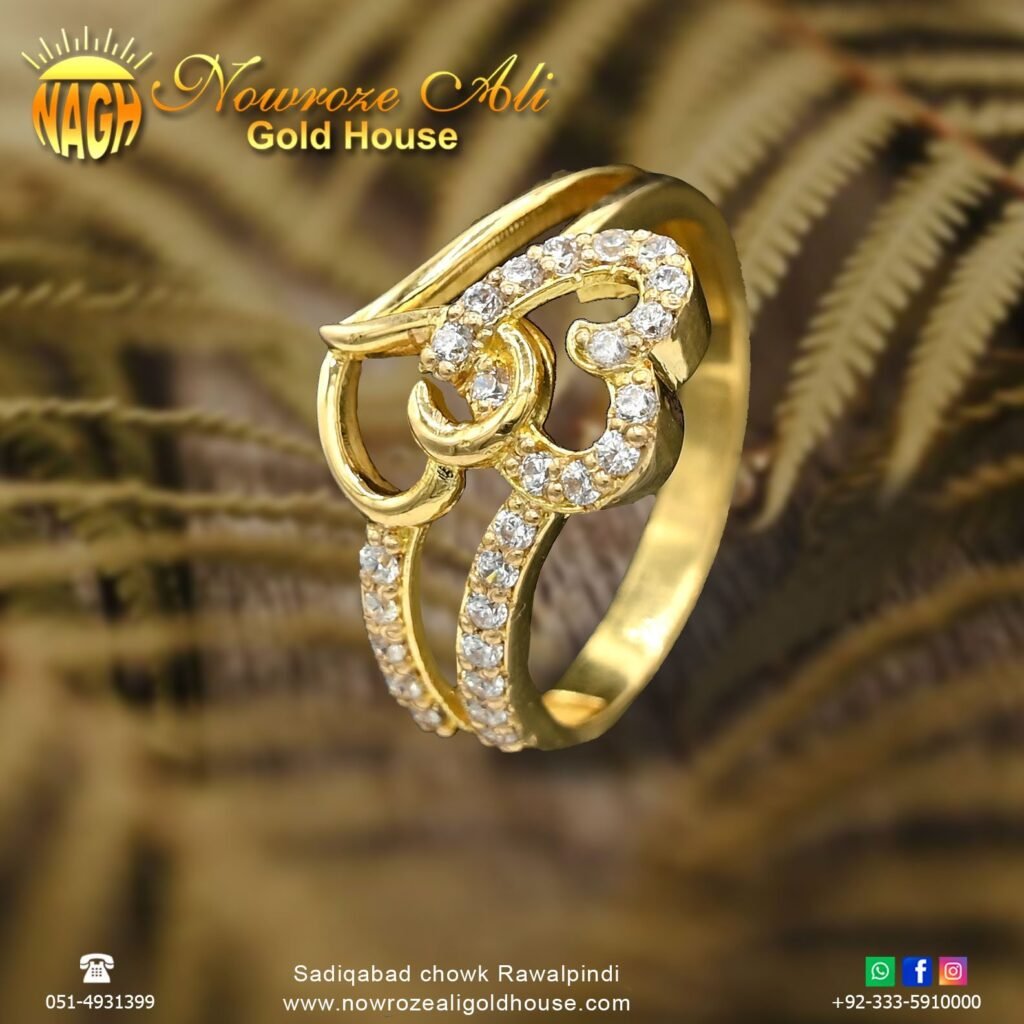
Casting: Molten gold is poured into a mold to create the ring’s basic form, which is then refined, polished, and finished by hand. This method is commonly used for both simple bands and rings featuring more complex three-dimensional detailing.
Hand Fabrication: For certain designs, particularly simple bands or highly customized pieces, goldsmiths shape the ring directly from gold sheet or wire, using techniques such as forging, soldering, and hand-finishing to achieve the desired form.
Stone Setting: For rings featuring gemstones, precise setting techniques—including prong, bezel, pave, and channel settings—ensure that stones are securely held in place while maximizing their brilliance and visual impact. This is a particularly critical skill for engagement and eternity rings, where secure stone setting is essential for long-term durability.
Engraving: Skilled artisans use specialized tools to carve intricate designs, inscriptions, or personal messages directly into the ring’s surface, a technique particularly important for signet rings, wedding bands featuring personal inscriptions, and other customized pieces.
Filigree and Milgrain Detailing: Techniques involving fine gold wirework or small beaded edging add intricate texture and vintage-inspired detail to certain ring designs, particularly popular in Art Deco-inspired and antique reproduction styles.
Sizing and Resizing: Given that rings must fit precisely for both comfort and security, goldsmiths must carefully size rings to the wearer’s finger, and many rings can be resized later if needed, through careful cutting, stretching, or addition of metal.
Modern jewelers increasingly use computer-aided design (CAD) and 3D printing technology to prototype and produce intricate ring designs with greater precision, though many fine and custom pieces still rely heavily on hand craftsmanship for finishing touches and detailed stone setting work.
Cultural and Symbolic Significance
Gold rings carry rich, varied symbolic meaning across different cultures and contexts:
In Western cultures, the wedding and engagement ring tradition remains one of the most universally recognized symbols of romantic commitment, with the ring’s unbroken circular form representing eternal love and unity between partners.
In many South Asian cultures, gold rings are exchanged during engagement ceremonies and often incorporated into broader bridal jewelry traditions, symbolizing familial blessing, prosperity, and the formal joining of two families.
In Christian religious tradition, the episcopal ring worn by bishops symbolizes their spiritual commitment to the Church, while wedding rings exchanged during Christian marriage ceremonies carry deep symbolic and sacramental significance.
In various professional and academic contexts, class rings and signet rings serve as symbols of institutional affiliation, achievement, and personal or familial identity, often worn with pride as a marker of accomplishment or heritage.
In many cultures, gold rings are also given as gifts to commemorate significant life milestones, such as graduations, birthdays, or professional achievements, symbolizing celebration and continued good fortune.
Buying Guide: What to Consider When Purchasing a Gold Ring
When shopping for a gold ring, several important factors should guide your decision:
Purpose and Occasion: Consider whether the ring is intended for engagement, marriage, everyday wear, ceremonial use, or as a fashion statement, as this will influence the ideal style, karat, and design complexity.
Karat and Purity: As discussed, higher karat gold offers richer color but reduced durability, while lower karat gold offers greater durability at some expense of color richness. Given the significant wear rings endure, 14K or 18K gold is often recommended for rings intended for daily use.
Ring Sizing: Proper sizing is particularly critical for rings, given that an ill-fitting ring can be both uncomfortable and prone to slipping off or becoming difficult to remove. Professional sizing at the time of purchase is strongly recommended.
Gemstone Considerations: For rings featuring gemstones, consider factors such as stone quality, setting security, and how well the setting protects the stone from everyday impact, particularly important for rings worn continuously.
Hallmarks and Certification: Always check for purity hallmarks and, for rings featuring diamonds or other valuable gemstones, request appropriate certification from reputable grading laboratories.
Comfort and Lifestyle: Consider how the ring’s design, weight, and profile will suit your daily activities and lifestyle, particularly for rings intended for continuous, long-term wear.
Reputation of the Seller: Purchase from established, reputable jewelers to ensure authenticity and quality, particularly for significant purchases such as engagement or wedding rings.
Budget and Market Value: Gold prices fluctuate based on market conditions, so understanding current gold rates can help buyers make informed decisions, particularly for larger or gemstone-set pieces.
Caring for a Gold Ring
Because rings endure more direct, continuous physical contact than almost any other jewelry type, proper care is especially important.
Regular Cleaning: Clean gold rings periodically using a soft cloth and mild soap solution to remove oils, dirt, and residue that accumulate from constant hand contact and daily activities.
Remove Before Physical Activity: Take off gold rings before exercising, doing manual labor, gardening, or engaging in activities involving harsh chemicals, as physical impact and chemical exposure can scratch, bend, or damage the metal and any gemstone settings.
Mind Handwashing and Lotions: Frequent handwashing and the application of lotions or hand sanitizers can leave residue on rings over time, so periodic thorough cleaning helps maintain their appearance and shine.
Periodic Professional Inspection: For rings featuring gemstones, periodic professional inspection is particularly important to catch loose stones, worn prongs, or weakened settings before they result in stone loss or damage.
Proper Storage: When not being worn, store rings separately from other jewelry, ideally in a lined jewelry box or ring holder, to prevent scratching from contact with harder materials or other pieces.
Resizing as Needed: Because finger size can change over time due to weight fluctuations, temperature, or other factors, periodic resizing may be necessary to maintain both comfort and security of fit.
Gold Rings as an Investment
Like other forms of gold jewelry, gold rings can serve as a meaningful investment, particularly higher-karat pieces with minimal additional embellishment. Simple gold bands, valued primarily on weight and purity, tend to closely track the market value of gold, offering a relatively stable long-term store of value.
However, rings featuring diamonds or other precious gemstones involve additional valuation considerations beyond the gold itself, including stone quality, cut, clarity, and carat weight. For those purchasing engagement rings or other gemstone-set pieces primarily as an investment, it’s worth understanding that resale value often does not fully reflect original retail price, given the significant markup typically associated with retail jewelry sales, design labor, and craftsmanship costs. Those purchasing primarily for investment purposes often prioritize simplicity, purity, and weight, while those purchasing for engagement, wedding, or sentimental purposes typically prioritize meaning, design, and craftsmanship instead.
Modern Trends in Gold Ring Design
Contemporary jewelry design continues to shape and reshape the gold ring in interesting ways:
Stacking Rings: A significant trend involves wearing multiple thin gold rings stacked together on one or more fingers, allowing for personalized combinations and a dynamic, layered aesthetic.
Mixed Metals: Designers increasingly combine gold with silver, rose gold, or other materials within a single ring or across a stacked collection, creating contrasting textures and modern visual interest.
Personalized and Engraved Pieces: Custom engravings, including initials, meaningful dates, or short inscriptions, have become increasingly popular, allowing wearers to imbue their rings with personal significance.
Sustainable and Ethical Gold: Growing awareness of ethical sourcing has led many consumers, particularly in the engagement ring market, to seek out rings made from recycled gold or gold certified as responsibly and ethically mined.
Minimalist Designs: Simple, understated gold bands and delicate ring designs have grown increasingly popular, reflecting broader minimalist trends in fashion and everyday style.
Alternative Engagement Ring Designs: Moving beyond traditional diamond solitaires, many couples are increasingly choosing engagement rings featuring colored gemstones, vintage-inspired settings, or unique, non-traditional designs that reflect personal style rather than convention.
Conclusion
The gold ring stands as one of the most universally significant and enduring forms of jewelry in human history, its unbroken circular form carrying profound symbolic weight across cultures, religions, and centuries. From the seal rings of ancient Egyptian pharaohs to the wedding bands exchanged at modern altars, from signet rings marking family lineage to contemporary statement pieces expressing personal identity, the gold ring has continuously adapted while retaining its core symbolic power: permanence, commitment, and connection.
Understanding its rich history, the nuances of gold purity, the diversity of styles available, and proper care practices allows both buyers and wearers to make informed, meaningful choices. Whether chosen as a symbol of romantic commitment, a marker of family heritage, a religious or ceremonial object, or simply a beautiful piece of personal adornment, a gold ring represents far more than material worth—it carries stories, commitments, and personal significance that continue to be written with every wearer who chooses to make it their own.
As fashion and design trends continue to evolve, the fundamental appeal of the gold ring remains unchanged: a beautiful, durable, and deeply symbolic piece of jewelry that connects the wearer to a legacy spanning millennia, while offering endless possibilities for personal expression in the present day.