In the heart of Gold Jewellery Shop Rawalpindi’s bustling commercial district lies a sanctuary of craftsmanship and heritage: Nowroze Ali Gold House. For generations, the name has been synonymous with purity, intricate design, and the timeless allure of gold. it is a symbol of security, a token of love, and a centerpiece of matrimonial tradition.
From the technicalities of karatage to the emotional resonance of bridal sets, we delve deep into what makes Nowroze Ali Gold House a cornerstone of the local jewellery market.
1. The Heritage of Nowroze Ali Gold House
Located in the vibrant area of Sadiqabad, Rawalpindi, Nowroze Ali Gold House (and its sister concerns, often referred to as Nowroze Ali Jewellers) has built a reputation on trust. In a market where the “purity” of gold is often a subject of debate, this house has maintained a standard that keeps families returning for decades.
A Legacy in Sadiqabad
The store is situated at Chowk Sadiqabad, Chirah Road, a hub for gold seekers in Rawalpindi. Unlike the high-street malls of Islamabad, the Rawalpindi gold market offers a raw, authentic experience where negotiation and personal relationships with the “Zargar” (goldsmith) are part of the buying ritual. Nowroze Ali has navigated this landscape by blending traditional hospitality with modern retail standards.
2. Understanding Gold Purity and Karatage
Before purchasing from any reputable dealer, a buyer must understand what they are paying for. At Nowroze Ali, the focus is predominantly on 21K and 22K gold, which are the standards for Pakistani jewellery.
The Karat Breakdown
- 24 Karat (24K): This is 99.9% pure gold. While it is the most valuable, it is rarely used for intricate jewellery because it is too soft. It is typically sold as “biscuits” or coins for investment.
- 22 Karat (22K): This contains 22 parts gold and 2 parts other metals (like copper or zinc). This is the standard for heavy bridal sets and traditional bangles.
- 21 Karat (21K): A popular choice for more delicate items like chains and rings, providing a balance between the rich yellow of gold and the durability needed for daily wear.
Expert Tip: When buying from Nowroze Ali, always ask for the “Kanta” (weight) and the current market rate per Tola. As of April 2026, the gold market has seen significant fluctuations, with prices hovering around Rs. 480,000 to Rs. 505,000 per Tola.
3. The Collections: From Daily Wear to Bridal Splendor
Nowroze Ali Gold House caters to a wide spectrum of needs. Whether it’s a “Nath” (nose ring) for a small celebration or a “Rani Haar” (Queen’s necklace) for a grand wedding, the variety is exhaustive.
Bridal Masterpieces
In Pakistan, the “Buraqi” or bridal set is the crowning glory of a woman’s dowry. Nowroze Ali specializes in:
- Choker Sets: Hugging the neck closely, these often feature “Kundan” work or intricate “Filigree.”
- Rani Haar: Long, multi-layered necklaces that signify status and elegance.
- Jhumkas and Saharas: Traditional bell-shaped earrings, often supported by chains (Saharas) that pin into the hair.
Contemporary and Light-Weight Designs
Recognizing the shifting trends and the rising cost of gold, the shop offers a “Lite Weight” collection. These pieces use modern laser-cutting techniques to create voluminous designs that use less gold, making them affordable yet visually striking.
- Gold Tops (Earrings): Available in weights as low as 0.5 grams.
- Casual Rings: Minimalist bands and floral patterns for daily use.
4. The Economics of Gold in 2026
Buying gold at Nowroze Ali Gold House is not just a fashion choice; it is an economic strategy. In 2026, gold remains the ultimate hedge against inflation in Pakistan.
Price Transparency
The store follows the rates set by the All-Pakistan Gems and Jewellers Sarafa Association (APGJSA). Buyers should be aware of two main costs:
- The Gold Value: The weight of the gold multiplied by the daily rate.
- Making Charges (Mazdoori): This is the fee for the craftsman’s labor. At Nowroze Ali, making charges vary based on the complexity of the design—handcrafted Kundan pieces command a higher fee than machine-made chains.
5. Services and Customer Trust
What sets Nowroze Ali Gold House apart is their suite of services designed to ensure long-term customer satisfaction.
- Customization: Customers can bring in their own designs or sketches. The master artisans at the shop can replicate international designs with local 22K gold.
- Buy-Back Policy: A hallmark of a trusted jeweler is their willingness to buy back their own gold. Nowroze Ali offers competitive buy-back rates, usually only deducting the making charges and a small percentage for “wastage.”
- Cleaning and Polishing: Gold loses its luster over time due to dust and chemicals. The shop provides professional ultrasonic cleaning services to restore the original shine.
6. How to Reach and Shop
For those planning a visit to Nowroze Ali Gold House, timing and preparation are key.
- Location: Sadiqabad Road, Rawalpindi. It is easily accessible from both Murree Road and the Islamabad Expressway.
- Operating Hours: Typically 11:00 AM to 9:00 PM. Note that most gold markets in Rawalpindi remain closed on Fridays or open only after Jumu’ah prayers.
- Online Presence: While gold is best bought in person, they maintain a presence on platforms like YouTube and WhatsApp to showcase new arrivals.
The Complete Compendium: Nowroze Ali Gold House and the Heritage of Rawalpindi Gold
In the tapestry of Rawalpindi’s historical markets, gold is the golden thread that binds generations. Among the stalwarts of this trade, Nowroze Ali Gold House (often known colloquially as Nowroze Ali Jewellers) stands as a landmark of reliability. Nestled in the heart of Sadiqabad, this establishment has weathered economic shifts and style evolutions to remain a primary destination for those seeking the “yellow metal” in its most artistic forms.
The relationship between a family and their jeweler in Pakistan is sacred. It is built over decades of trust, where a shop is chosen not just for its storefront, but for the purity of its metal and the honesty of its weights. This article provides an exhaustive look into the world of gold jewellery through the expertise found at Nowroze Ali Gold House.
1. Geographical and Cultural Context
Rawalpindi, an ancient city with roots stretching back to the Gandhara civilization, has always been a hub of trade. The gold markets here, particularly Sarafa Bazaar and the growing cluster in Sadiqabad, represent a unique subculture.
The Sadiqabad Hub
While Sarafa Bazaar near Raja Bazaar is the historic center, Sadiqabad has emerged as the modern gold corridor of Rawalpindi. Located on Chirah Road at Chowk Sadiqabad, Nowroze Ali Gold House benefits from being in a more accessible, albeit still bustling, part of the city. This area caters to the residential belts of Satellite Town, Gulzar-e-Quaid, and even the nearby capital, Islamabad.
Cultural Significance
In Pakistan, gold is rarely just a “purchase.” It serves three distinct roles:
- Investment (Zarkhaiz): A hedge against the devaluation of the Rupee.
- Social Status (Waqar): A display of family wealth during public gatherings.
- Religious/Traditional Rite (Meher and Dowry): A mandatory or customary part of Islamic marriage and family inheritance.
2. Technical Mastery: The Standards of Purity
One of the most critical aspects of buying gold at a reputable house like Nowroze Ali is understanding the Karat system. While international markets often deal in 14K or 18K for retail, the Pakistani market is strictly traditional.
The 21K vs. 22K Debate
There is often confusion among buyers regarding the purity of Pakistani jewellery.
- 21K Gold: This is the unofficial “official” standard for most Pakistani jewellery. It contains 87.5% pure gold. The remaining 12.5% consists of alloys like copper, silver, and zinc to provide the hardness necessary for intricate designs.
- 22K Gold: Containing 91.6% pure gold, this is preferred for solid items like heavy bangles or “Kangan.” Nowroze Ali provides both, ensuring that every piece is stamped with its respective purity mark.
The Role of the “Kanta” (Scale)
Precision is everything. At Nowroze Ali, the digital scales are calibrated to provide readings in Grams and Tolas.
Unit Conversion Table:
Unit Equivalent in Grams 1 Tola 11.66 Grams 1 Masha 0.972 Grams 1 Ratti 0.121 Grams
3. Signature Collections at Nowroze Ali
The inventory at Nowroze Ali Gold House is a blend of the ancient and the avant-garde. Their master craftsmen, or Karigars, are skilled in several distinct styles.
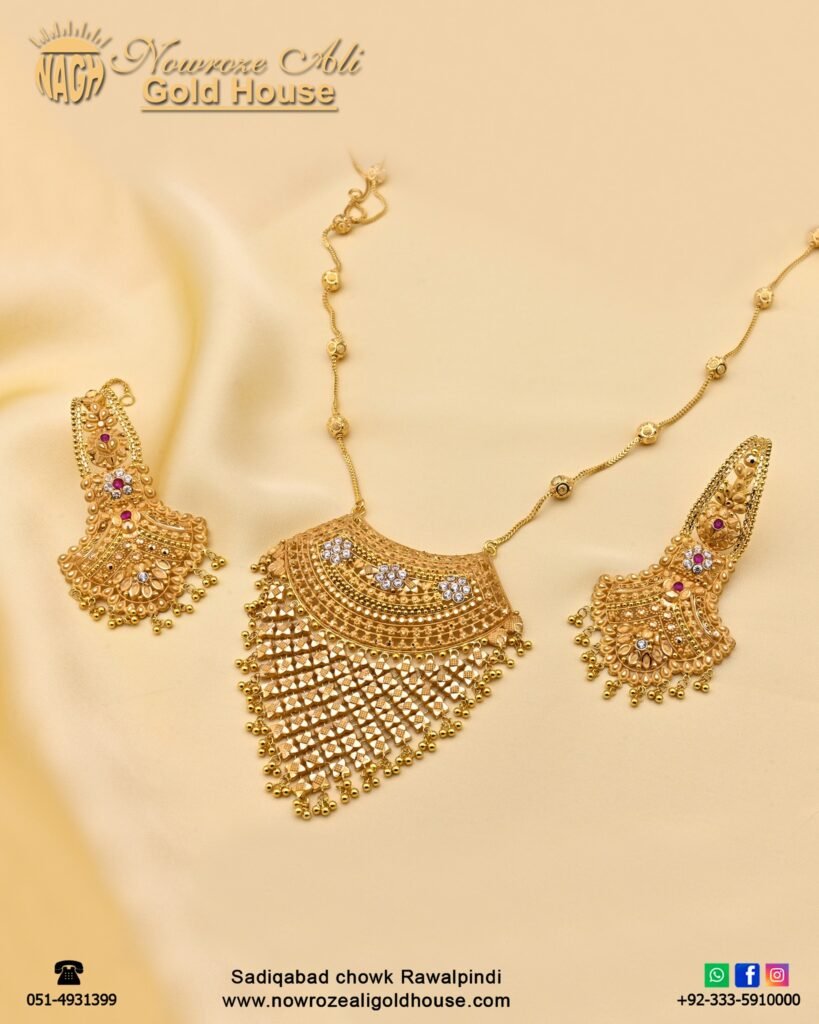
A. The Bridal “Sulah” (Set)
A full bridal set from Nowroze Ali usually consists of:
- The Guluband: A tight-fitting necklace or choker.
- The Mala: A long stringed necklace, often featuring pearls or gold beads.
- Jhumar/Passa: A headpiece worn on the side of the head, a staple of Punjabi and Mughal-inspired bridal wear.
- Nath: The traditional nose ring, which can range from a simple hoop to a heavy, chain-supported ornament.
B. Kundan and Polki Work
Kundan is one of the oldest forms of jewellery in South Asia. It involves setting highly refined gold foil between stones and the mount. At Nowroze Ali, you will find:
- Meenakari: Enamelling on the reverse side of gold pieces, adding a splash of color (usually red or green) that complements the gold.
- Polki: Uncut diamonds set in gold, giving a raw, vintage look that is currently highly trendy in Rawalpindi’s elite circles.
C. The Bangle Gallery
Bangles are the most sold item in any Rawalpindi gold house. Nowroze Ali offers:
- Churi: Thin, delicate bangles usually sold in sets of 6 or 12.
- Kara/Kangan: Thick, heavy bracelets often featuring lion or floral motifs at the “lock” or “hook.”
- Machine-Cut Bangles: Modern designs with high-precision facets that catch the light like diamonds.
4. The Buying Process: A Step-by-Step Guide
Buying gold is an art form in itself. When you enter Nowroze Ali Gold House, the process follows a traditional sequence.
Phase 1: Selection and Weight
You browse the displays. Once a piece is selected, it is placed on the digital scale. The weight is recorded in front of the customer.
Phase 2: Pricing the Gold
The price is calculated based on the Gold Rate of the Day. In Rawalpindi, the “Sarafa Association” typically announces the rate around 2:00 PM to 3:00 PM daily. If you are buying in the morning, the shop may use the previous day’s closing rate or an estimated floating rate.
Phase 3: The “Mazdoori” (Making Charges)
This is the labor cost. For a standard machine-made chain, the making charges might be as low as Rs. 1,500 per Tola. For a handcrafted, intricate bridal set, this can climb significantly. At Nowroze Ali, transparency in making charges is a key part of their business model.
Phase 4: The Invoice (The Parchi)
Never leave without the official invoice. This document is your proof of purity. It should list:
- The total weight.
- The Karatage (21K/22K).
- The daily gold rate.
- The making charges.
- The store’s stamp.
5. Investment Advice: Gold Bars and Biscuits
For those not interested in jewellery, Nowroze Ali Gold House also deals in investment-grade gold. This is often sold in the form of:
- TT Bars (Ten Tola Bars): The standard for large-scale investors.
- Gold Coins: Available in 1/2 Tola and 1 Tola denominations, these are popular as wedding gifts or “Eidi.”
Buying bars is generally more profitable as an investment because they carry zero making charges or very minimal “premium” fees compared to jewellery.
6. Maintenance and Longevity
Gold is durable, but not invincible. Nowroze Ali offers a maintenance service for all their customers.
- Cleaning: Over time, skin oils and dust settle in the crevices of intricate designs. A professional ultrasonic cleaning can restore the original 22K luster.
- Resizing: Whether it’s a ring that has become too tight or a necklace that needs an extension chain (Dori), the in-house goldsmiths can adjust pieces within hours.
- Repairing: Solder points on delicate chains can break. Nowroze Ali uses “Cadmium-free” soldering to ensure the purity of the piece isn’t compromised during repairs.
7. The 2026 Gold Market Outlook
As of late April 2026, the gold market in Pakistan is experiencing unprecedented highs. For customers at Nowroze Ali, this has led to a shift in buying behavior.
- The Rise of 18K: While 21K remains king, more younger couples are opting for 18K gold (75% purity) for engagement rings to allow for larger diamond or gemstone settings.
- Hollow Technology: Many new designs at the shop utilize hollow-tube technology, allowing a necklace to look like it weighs 5 Tolas while actually only being 2 Tolas. This makes high-end fashion accessible despite soaring prices.
Expanding the Narrative: The Technical Artistry and Community Role of Nowroze Ali Gold House
Beyond the storefront, the operations of Nowroze Ali Gold House in Rawalpindi offer a masterclass in the intersection of traditional metallurgy and modern retail. To truly understand the “full details” of this establishment, one must look at the specific craftsmanship techniques, the intricate seasonal cycles of the gold trade in Pakistan, and the psychological role of gold in the local community.
9. The Craftsmanship: Techniques of the Artisans
The “Nowroze Ali” signature is often defined by the level of hand-finishing applied to each piece. In Rawalpindi, the distinction between “machine-made” and “hand-carved” is the primary factor in a piece’s long-term value.
Filigree and Granulation
Many of the necklaces found at Nowroze Ali feature Filigree—the art of twisting thin threads of 21K gold into lace-like patterns. This is often combined with Granulation, where tiny beads of gold are fused to the surface to create texture. These techniques require a steady hand and a “Zargar” with decades of experience, as the high purity of the gold makes it exceptionally soft and prone to melting if the heat is not perfectly controlled.
Die-Struck and Laser Cutting
For their more modern, affordable collections, the shop utilizes Die-Struck methods. This involves pressing a sheet of gold into a steel mold. The result is a lightweight yet sturdy piece that mimics the look of a solid cast ornament. This is particularly popular for “Bangles” and daily-wear “Tops” (stud earrings), allowing customers to maintain a prestigious look without the weight of 5-6 Tolas of gold.
10. The Seasonal Cycle of the Gold Market
In Rawalpindi, the trade at Nowroze Ali Gold House follows the rhythmic pulse of the Islamic calendar and the agricultural harvest cycles.
- The Wedding Season (Shadi Season): Usually peaking after Eid-ul-Fitr and through the winter months, this is when the shop is at its busiest. During this time, the “Karigars” (artisans) often work overtime to meet the demand for custom bridal sets.
- The Month of Ramadan: Interestingly, while retail for many items slows down, gold often sees a spike in “investment buying” as families calculate their Zakat (obligatory charity). Many also choose this time to trade in old, broken jewellery for new pieces in preparation for Eid.
- Muharram: Traditionally, this is a quieter period for gold sales in Rawalpindi, as celebrations are curtailed. Savvy buyers often use this “off-season” to negotiate better making charges, as the shop-floor traffic is lower.
11. The “Old Gold” Exchange Program
A significant portion of the business at Nowroze Ali Gold House involves the recycling of family wealth. This is the “Exchange” system.
The Valuation Process:
When a customer brings in “Old Gold” (often jewellery from the 80s or 90s), the experts at Nowroze Ali perform a “Nitric Acid Test” or use a modern XRF Gold Testing Machine to determine the exact purity.
- Melting: If the purity is verified, the gold is melted into a button.
- Credit: The customer is given credit based on the “Raw Gold” price of the day.
- The New Piece: This credit is then applied to a new design, with the customer only paying the difference in weight and the new making charges.
This cycle ensures that wealth stays within the family, simply changing shape to match the fashion of the new generation.
12. Security and Privacy in the Gold House
For a high-stakes business like gold jewellery in Sadiqabad, security is paramount. Nowroze Ali Gold House employs a multi-layered approach to ensure customer safety.
- Private Viewing Rooms: For high-value bridal purchases, the shop provides private areas where families can discuss prices and try on heavy sets away from the public eye. This is a cultural necessity in Rawalpindi, where “Parda” (privacy) and safety are equally prioritized.
- Insured Logistics: For customers who order from outside Rawalpindi (including the Pakistani diaspora in the UK or UAE), the shop utilizes secure, insured couriers to ensure that the gold reaches its destination without tampering.
13. The Socio-Economic Impact on Sadiqabad
Nowroze Ali is more than just a retail outlet; it is an economic engine for the local Chirah Road area.
- Employment: The house supports a network of independent Karigars, stone-setters, and polishers.
- Ancillary Trades: The success of the gold house fuels nearby businesses, such as velvet box makers, specialized “Dori” (thread) weavers who create the adjustable neck-strings for gold sets, and local gemstone dealers.
- Community Trust: In times of financial crisis, many locals view Nowroze Ali as a “de-facto” bank—a place where assets can be liquidated instantly for cash at fair market value, providing a safety net for the community.
14. Essential Information for the Modern Buyer
To ensure a seamless experience at Nowroze Ali Gold House, keep the following logistical details in mind:
| Feature | Details |
| Primary Address | Chowk Sadiqabad, Chirah Road, Sadiqabad, Rawalpindi, 46000 |
| Contact Number | +92 51 4931222 / WhatsApp: +92 300 5630000 |
| Specialization | 21K/22K Bridal Gold, Diamond Jewellery, Investment Biscuits |
| Service Days | Saturday to Thursday (Friday is typically the weekly holiday) |
| Peak Hours | 4:00 PM to 8:00 PM |
15. Summary of the Nowroze Ali Experience
The allure of Nowroze Ali Gold House lies in its ability to offer a “complete” experience. It is not merely the transaction of metal for money; it is the consultation on what suit will best fit a bride’s face shape, the advice on which gold bar is best for a long-term saving plan, and the assurance that the 21K stamp on the back of a ring is an iron-clad guarantee.
In the fast-paced world of 2026, where digital assets and paper money fluctuate, the gold from this Rawalpindi institution remains a solid, shining constant. It is an investment you can touch, a heritage you can wear, and a legacy that—much like the house itself—is built to last.
Conclusion: Why Nowroze Ali?
In the crowded streets of Rawalpindi, many shops glitter, but few offer the legacy that Nowroze Ali Gold House provides. Their commitment to the “Rawalpindi Rate,” their open-door policy for cleaning and valuation, and their deep roots in the Sadiqabad community make them more than just a store—they are guardians of a golden tradition.
Whether you are stepping in for a small pair of earrings for a child or a grand set that will define a wedding day, you are participating in a ritual that is as old as the city itself. Gold is the memory of the past and the insurance for the future, and at Nowroze Ali, that gold is handled with the respect it deserves.