


For centuries, the gold ring has occupied a position of profound significance within the social fabric of South Asia. More than a simple piece of personal adornment, it serves as a repository of wealth, an emblem of marital commitment, a token of familial love, and a testament to the master metalworkers who forge it. Within the modern boundaries of Pakistan, few urban centers can boast a jewelry-making heritage as deep, complex, and vibrant as the historic city of Rawalpindi. Nestled adjacent to the capital city of Islamabad, Rawalpindi—affectionately known as Pindi—retains an old-world charm where ancient trade routes intersect with contemporary retail dynamics.
At the heart of this thriving commerce is the gold ring. Whether it is a minimalist, heavy masculine signet ring set with a raw Carnelian stone or an intricate, delicate bridal filigree ring meticulously detailed with 22-karat wirework, the rings created in Rawalpindi tell a story of cultural continuity and economic endurance. This comprehensive article explores the multi-faceted universe of gold rings within Rawalpindi, diving deep into the historical corridors of its gold markets, the nuances of local design aesthetics, the scientific realities of the gold trade, and the consumer behavior that dictates how these precious objects are bought, sold, and cherished.
1. The Historical Heart of Rawalpindi’s Gold Trade: Sarafa Bazaar
To understand the true essence of a gold ring manufactured or purchased in Rawalpindi, one must travel into the labyrinthine alleys of the old city. While modern shopping centers have emerged across the broad avenues of the newer neighborhoods, the spiritual and historic center of Rawalpindi’s jewelry trade remains firmly rooted in the legendary Sarafa Bazaar.
The Evolution of the Old Market
Located near the historic Raja Bazaar and the arterial Murree Road, Sarafa Bazaar has served as the primary trading ground for precious metals for generations. Its history predates the partition of the subcontinent, originating during an era when Hindu, Sikh, and Muslim artisans worked side-by-side in tiny, elevated wooden shopfronts. These master craftsmen, known colloquially as Sunars, developed a distinct regional style that blended the heavy, solid metalwork preferred by the agrarian communities of the surrounding Pothohar Plateau with the refined, delicate designs influenced by Mughal court aesthetics.
Following the geopolitical shifts of 1947, the physical market underwent demographic changes, but the fundamental trade structures remained unbroken. Families that had spent generations learning the exact pressure required to stamp a design into gold sheet established modern roots here. Today, as you walk through the narrow, crowded streets of Sarafa Bazaar, the ambient soundscape is defined by a rhythmic counterpoint: the hum of modern electronic gold-testing machinery layered over the rhythmic, metallic tap-tap-tap of miniature hammers hitting iron anvils in hidden upper-floor workshops.
The Workspace of the Artisan
The tools surrounding them represent a bridge across centuries. On one side sits a traditional oil-fired or gas-powered blowpipe used to direct a precise needle of flame onto a ceramic crucible (ghariya), melting down scrap 24-karat bullion into a workable alloy. On the other side sits a modern digital micro-scale capable of measuring down to the milligram, alongside specialized German pliers, diamond-tipped engraving styluses, and vulcanized rubber molds. It is within these hidden spaces that the journey of a Rawalpindi gold ring begins, transforming a raw lump of state-regulated bullion into an absolute work of wearable art.
2. Pothohar and Pindi Aesthetics: Design Typologies of the Gold Ring
The aesthetic character of a gold ring made in Rawalpindi is deeply influenced by the demographics of its buyers. The city serves as a regional capital not just for its urban citizens, but also as a commercial hub for the surrounding districts of Attock, Jhelum, Chakwal, and Azad Jammu & Kashmir. This creates an fascinating spectrum of designs, ranging from massive, traditionalist statements of rural wealth to the sleek, ultra-minimalist geometries demanded by the young corporate class working in nearby Islamabad.
Bridal and Formal Rings
In Pakistan, the purchase of wedding jewelry is an exercise in both emotional expression and financial security. Within Rawalpindi’s bridal markets, gold rings are categorized based on their manufacturing technique and cultural intent:
- The Kundan Ring: A classic design technique that traces its roots directly to the royal courts of Rajasthan and the Mughals. Kundan refers to the hyper-purified, highly malleable 24-karat gold foil used to set gemstones without the use of prongs. The artisan constructs a solid gold frame, positions the stones (frequently emeralds, rubies, or glass doublets), and then meticulously packs the fine gold foil around the edges using hot steel tools. A Rawalpindi bridal Kundan ring is often massive, shaped like an open lotus flower or a crescent moon (chaand), covering nearly the entire knuckle of the wearer.
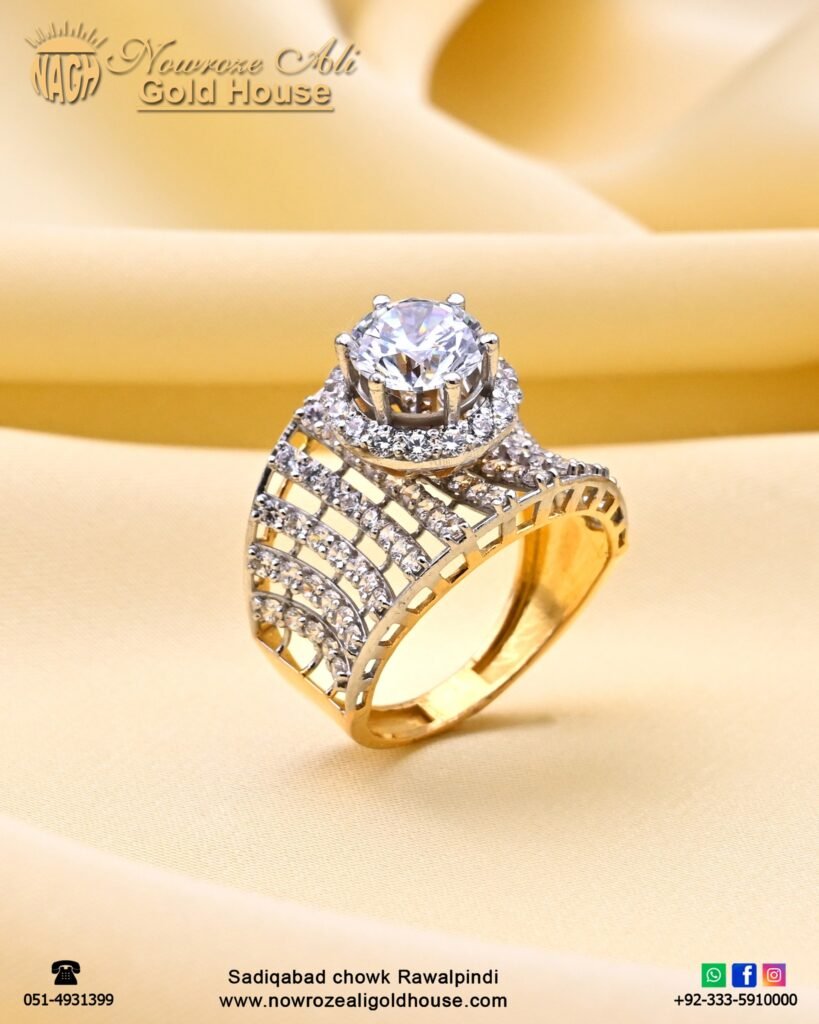
- Filigree and Wirework (Taar-Kashi): Highly favored by families looking for a high-volume, visually dramatic ring that remains light on the finger and respectful of a strict budget. Master craftsmen pull gold through successively smaller holes in a steel die plate until it reaches the thickness of a human hair. This wire is then twisted, crimped, and soldered onto a structural frame to create stunning, lace-like floral arrangements.
- The Thappa (Stamped or Die-Struck) Ring: This traditional technique uses heavy iron or steel dies onto which ancient geometric patterns have been hand-carved. A thin sheet of 22-karat gold is placed over the die and struck with a heavy mallet, transferring the high-relief pattern instantly. The hollow underside is then reinforced with a flat backing plate. Thappa rings are incredibly popular for engagement ceremonies (Mangi) in the Pothohar region due to their highly reflective, polished surfaces and substantial visual presence.
Men’s Gold Rings: The Signet and the Gemstone
Unlike western traditions where men’s jewelry is often restricted to plain, understated bands, the men of Rawalpindi have a historical love affair with substantial gold rings. These rings are designed to exude authority, lineage, and spiritual devotion.
The dominant style is the Signet Ring (Khatam), featuring a wide, heavy gold shank that tapers up to a broad, flat face. While some signet rings feature deep hand-engraving of the wearer’s familial initials or crescent-and-star motifs, the overwhelming majority are designed around a central gemstone.
The selection of these stones is rarely purely aesthetic; it is deeply intertwined with Islamic astrological beliefs and spiritual traditions (ilm-ul-nujoom). The ring styles are tailored to hold specific stones in ways that allow light to pass through or keep the stone in direct contact with the skin:
- Aqeeq (Carnelian/Agate): The most popular stone for Muslim men in Rawalpindi, traditionally set into a thick, satin-finished 21-karat or 18-karat yellow gold frame. The designs favor clean, rugged bevels rather than high-polish shine.
- Feroza (Turquoise): Sourced traditionally from Iran or Afghanistan, the bright blue-green stone is paired with a heavy, step-shouldered gold ring design that mirrors ancient Persian and Central Asian metalwork.
- Yaqoot (Ruby) and Zamarrud (Emerald): These precious gems are reserved for high-status signet rings, often flanked by deep hand-carved vertical grooves along the gold band to emphasize the rugged masculinity of the piece.
3. The Pindi Gold Ecosystem: Weights, Purity, and Calculations
To buy a gold ring in Rawalpindi without understanding the localized mathematical systems used by the Sarafa association is to navigate a complex language blindfolded. The trade relies on an ancient system of weights that exists alongside the metric system, requiring local jewelers to be fluent in converting between the two instantly.
The Measurement System: Tolas, Masha, and Ratti
While international gold markets trade exclusively in troy ounces and grams, Rawalpindi’s retail sector operates on the traditional subcontinent weight breakdown:
$$\text{1 Tola} = 12 \text{ Mashas} = 96 \text{ Rattis} = 11.6638 \text{ Grams}$$
When a customer walks into a jeweler in Saddar or Commercial Market to purchase a standard everyday ladies’ ring, the piece is rarely weighed in flat grams. Instead, the jeweler will place the ring on the digital scale and announce the weight as, for example, “Zero Tolas, four Mashas, and two Rattis.”
To help demystify this calculation, the following table illustrates the exact breakdown of the traditional weight system relative to modern metric grams, providing a clear reference for the foundational units used in every transaction:
The Carat Purity Dynamics
The purity of gold used in Rawalpindi rings is strictly categorized based on the intended function of the piece.
- 22-Karat Gold (91.6% Purity): The absolute gold standard for traditional Pakistani jewelry. Because 22k gold retains the rich, deep golden-orange hue prized by South Asian families, nearly all bridal rings, Kundan bases, and filigree pieces are manufactured in this alloy. To make it strong enough to hold its shape over a lifetime of wear, Rawalpindi artisans alloy the 24k pure gold with precise percentages of copper and silver.
- 21-Karat Gold (87.5% Purity): This alloy is highly popular in Rawalpindi for men’s rings and structural daily-wear bands. The higher percentage of base metals gives the ring added tensile strength, ensuring that fine details do not rub away under the friction of manual work or daily chores.
- 18-Karat Gold (75.0% Purity): Historically viewed with skepticism by traditional buyers who equated lower carats with lesser value, 18k gold has seen a dramatic resurgence in Rawalpindi’s contemporary markets. This shift is driven entirely by the popularity of diamond engagement rings and delicate white gold or rose gold bands. 18k gold provides the rigid hardness required to clamp platinum or steel prongs around precious diamonds, preventing them from shifting loose.
Deconstructing the Final Price
The retail price of a gold ring in Rawalpindi is never a single static figure. It is calculated dynamically at the counter using a transparent, multi-part formula that balances global economics with local manual labor:
The Daily Gold Rate is issued every afternoon by the All Pakistan Supreme Jewelers Association and is instantly broadcasted across WhatsApp networks to every shop in Rawalpindi. This rate fluctuates based on the international London Bullion Market prices and the real-time value of the Pakistani Rupee.
The Making Charges (Kari-Gari) represent the jeweler’s premium for the physical labor involved. For a simple machine-cut wedding band, the making charges might be a small flat fee per gram. However, for a complex, hand-carved ring that takes an artisan three days to finish under a magnifying glass, the making charges can climb significantly, representing a substantial portion of the ring’s overall cost.
4. Geographic Retail Zones: Where Rawalpindi Buys Gold
The physical distribution of gold ring retailers across Rawalpindi forms a fascinating geographic and socioeconomic map. Different neighborhoods cater to completely different consumer mindsets, budgets, and aesthetic desires.
Saddar: The Hub of Premium Retail and Diamond Setting
Moving away from the historic core, the sprawling commercial district of Saddar Rawalpindi represents the upscale face of the city’s jewelry trade. Along Bank Road and its intersecting avenues, the shopping experience transforms. Here, small, open-air shops are replaced by multi-story, air-conditioned showrooms featuring bulletproof glass facades, armed security personnel, and expansive velvet-lined display cases.
Saddar is the premier destination for families seeking certified diamond engagement rings and contemporary gold designs. The retailers here cater heavily to military families from the adjacent Cantonment areas, corporate executives, and affluent residents of the nearby DHA and Bahria Town suburbs. In these showrooms, the sales process is highly formalized; rings are accompanied by laminated laboratory certificates verifying stone clarity (such as VVS1 or VS2) and precise metal purity hallmarks.
Murree Road and Commercial Market: The Bridal Epicenters
The bustling Commercial Market in the heart of Satellite Town, alongside major plazas lining Murree Road, serves as the intermediate bridge between the ancient traditions of Sarafa Bazaar and the high-end luxury of Saddar.
Commercial Market is world-renowned as a one-stop-shop bridal destination. A family preparing for a wedding can purchase their clothing, formal shoes, and gold rings all within a two-block radius. The gold ring collections here are heavily focused on theatricality and size—perfectly matched to look stunning at a large wedding reception (Barat). The jewelers in this zone are masters of adaptation, quickly replicating international designs seen on social media platforms using local 21k or 22k yellow gold to satisfy the stylistic cravings of young brides.
5. Cultural Context and Life Milestones: The Ring as a Social Catalyst
In the cultural landscape of Rawalpindi, a gold ring is almost never purchased as a meaningless impulse buy. Its acquisition is deeply tied to specific life events, serving as a physical anchor for memory, transition, and social status.
The “Baat Pakki” and Engagement Ceremonies
The process of marriage in Rawalpindi typically begins with the formal engagement, locally referred to as the Baat Pakki (the confirmation of the word) or the Mangi. The centerpiece of this event is the exchange of gold rings.
Tradition dictates that the groom’s family visits the bride’s home bearing a gold ring, which is slid onto her finger by the groom’s mother or sister. This ring is a direct statement of the groom’s family’s economic standing and their respect for their future daughter-in-law.
Similarly, the bride’s family presents a substantial gold signet ring to the groom. In Pindi culture, this exchange is scrutinized with immense social interest. Relatives will crowd around to examine the weight, the brilliance of the polish, and the choice of stone, translating the physical dimensions of the gold ring into a metric of familial generosity and respect.
Aqiqa and the Celebration of New Life
The giving of gold rings extends to the very beginning of human life. During the Aqiqa ceremony—the Islamic tradition of shaving a newborn infant’s head and distributing meat to the community—it is incredibly common for grandparents, paternal uncles (Chachas), and maternal aunts (Khalas) to gift miniature gold rings to the baby.
These baby rings are tiny, feather-light creations, often weighing less than half a gram, crafted from highly malleable 22k gold to ensure there are no sharp edges that could scratch the infant’s delicate skin. Many feature small, protective motifs like a tiny blue turquoise bead or a stamped eye icon to ward off the “evil eye” (Nazar). As the child grows, these rings are carefully tucked away into velvet boxes inside heavy steel home safes, preserved forever as a physical reminder of the community that welcomed them into the world.
6. The Economics of Gold Rings: Investment vs. Adornment
To look at a Rawalpindi gold ring purely through the lens of fashion is to misunderstand the deeply ingrained economic survival mechanisms of South Asia. In a country that has historically navigated high inflation rates and currency devaluations, gold is viewed as the ultimate financial shield. The gold ring is an investment you can wear.
The Portability of Micro-Wealth
While buying large gold sets or heavy bars requires an immense upfront capital layout, the gold ring represents an accessible entry point for micro-investment. A working-class individual in Rawalpindi—whether a school teacher, a small shopkeeper, or a military officer—can realistically save enough capital to purchase a two-gram 22-karat gold ring every few months.
The Liquidity Factor: In times of sudden crisis—such as a medical emergency, a sudden school tuition deadline, or a business cash-flow shortage—the gold ring serves as immediate currency.
The owner does not need to navigate the slow bureaucracy of a bank loan. They can walk into any small jewelry shop in Sarafa Bazaar or Saddar, present the ring, have it weighed, and walk out fifteen minutes later with cold, hard cash based on that exact hour’s global gold rate.
The System of Exchange (Kat)
The local gold economy is designed to facilitate fluid asset trading through an institutionalized system known as Kat (the standard deduction rate for recycling gold). If a customer brings an old, dented gold ring purchased twenty years ago back to a Rawalpindi jeweler, the jeweler will execute a standard evaluation:
- The Fire Test: The gemstones are carefully pried out, and any dirt or residual oils are burned away over a clean flame.
- The Purity Assessment: The ring is scraped against a black touchstone (Kasoti) and treated with nitric acid to confirm if it is authentic 22k, 21k, or a lower-grade alloy.
- The Deduction Calculation: The jeweler melts the piece down into a raw button of gold, deducts a small, pre-agreed percentage (typically between 2% to 5%) to account for the original alloy impurities, and applies the current market rate to the remaining weight.
This elegant system ensures that the wealth stored within a gold ring is never truly lost; it is merely waiting to be melted down, recast, and reborn into a brand-new design for a new generation.
7. The Craft of the Kari-Gar: A Dying Art form or a Resilient Legacy?
Behind every exceptional gold ring sold in the glittering showrooms of Rawalpindi stands the Kari-Gar—the artisan builder whose eyes, hands, and lungs bear the physical cost of production. The structural survival of this craft is currently facing an interesting crossroads in the modern era.
The Transmission of Generational Knowledge
The skills required to transform high-karat gold into a durable ring are not taught in formal technical universities; they are passed down through a rigorous, unpaid apprenticeship system known as the Ustad-Shagird framework.
A young apprentice (shagird) typically enters the workshop around early adolescence, starting with the basic tasks of sweeping the workshop floor (a critical job, as the dust contains microscopic gold filings that are carefully recovered through water panning at the end of every week). Over years of silent observation and practice, the apprentice graduates to operating the hand-cranked rolling mills, drawing out fine wires, and eventually mastering the delicate art of micro-soldering using tiny gold alloy filings mixed with borax flux.
An artisan who has attained the rank of Ustad (Master) possesses an almost mystical intuitive understanding of the metal. They can judge the purity of hot, liquid gold simply by the precise shade of incandescent green it flashes inside the crucible, and they can shape a perfect ring shank using nothing but visual symmetry, completely eschewing calipers or digital measuring tools.
The Threat of Automation and CAD Technology
The traditional Kari-Gar faces a massive structural challenge from modern industrial technology. Computer-Aided Design (CAD) software paired with high-precision 3D resin printers has arrived in Rawalpindi’s major manufacturing centers.
Instead of an artisan spending twelve hours hand-carving a wax model for a complex floral ring, a digital designer can create the file on a screen in one hour. The file is sent to a 3D printer that outputs a perfect, hyper-precise resin prototype, which is then cast en masse using industrial vacuum casting machines.
While this automation has significantly lowered making charges for consumers and produced flawless symmetry, it lacks the soul, variance, and organic warmth of hand-hammered jewelry. The older generation of jewelers in Sarafa Bazaar fiercely maintain that a machine-made ring can never match the structural resilience or unique personality of a piece born from human hands.
8. Consumer Guide: How to Safely Buy a Gold Ring in Rawalpindi
For an ordinary consumer, navigating the fast-paced, high-stakes environment of a Rawalpindi jewelry market can be overwhelming. To ensure a secure, transparent transaction that protects your financial investment, buyers should adhere to a strict procedural checklist.
Critical Rules for the Buyer
- Insist on Bare Weight: Many gold rings are heavily embellished with synthetic zircons, glass beads, or real semi-precious stones. Never pay the price of gold for the weight of a stone. The jeweler must calculate the estimated stone weight and deduct it completely from the total weight of the ring before calculating the metal cost.
- Check the Inside Band for Hallmarks: Trustworthy jewelers stamp the inside shank of their rings with a tiny engraving indicating purity. Look closely for stamps like “22K”, “916”, or the specific initials of a reputable manufacturing house. If the band is completely smooth and devoid of any markings, demand a destructive or electronic touchstone test before handing over your payment.
- Understand the Receipt: A valid gold receipt in Rawalpindi is a powerful legal document. It must explicitly state the gross weight of the ring, the net weight of the gold, the exact carat purity, the specific daily gold rate applied, and the maker’s fee. Keep this receipt safe; without it, future resale or exchange value will drop drastically across any market in the country.
Conclusion: The Timeless Radiance of the Pindi Gold Ring
As Rawalpindi races forward into the twenty-first century, its physical and digital landscapes are transforming at an unprecedented rate. E-commerce storefronts allow citizens to browse collections on their mobile screens from the comfort of their homes, while digital payment gateways are gradually replacing the thick bricks of cash that have traditionally fueled the local economy.
Yet, despite these rapid systemic shifts, the fundamental human desire for the gold ring remains completely unchanged. The alleys of Sarafa Bazaar continue to echo with the strikes of miniature hammers, and the showrooms of Saddar still hum with the quiet murmurs of families planning their futures.
A gold ring forged in the crucible of Rawalpindi is far more than a simple investment asset or an elegant accessory. It is a brilliant, heavy piece of living history—an unbreakable golden thread that connects the ancient artisan traditions of the past directly to the romantic, familial, and economic hopes of the future.